The Freedom Blueprint (October ’26 Edition)

In Mick’s Musings I report back on the four recession indicators I mentioned last month. Three still say no. The fourth – what the weakest companies have to pay to borrow – has started to move the wrong way.
Both of our diy-investors portfolios are ahead since inception – the UK Active 10 by 53.17% and the US Active 10 by 5.18%. Since the September newsletter, though, they have gone in opposite directions: the UK has added 2.63% whilst the US has eased back 7.83%. The detail is below.
As ever, do please let me know what you would like me to cover.
Two Chokepoints, One Month On
Last month I finished my piece on the Red Sea and the Strait of Hormuz by saying that, as you read it, Gulf foreign ministers would be meeting Iran in Oman. They did not. The talks were postponed indefinitely the day before the newsletter went out, and the month since has taken a turn I did not expect.
The new front is not at sea. Between Monday 5th and Sunday 11th October the Houthis hit five Saudi airports with ballistic missiles and drones – Jazan, Najran, Abha, Dammam and, repeatedly, King Khalid International in Riyadh. On the 8th a parked Saudia airliner was destroyed and its captain was among three killed. On Saturday 10th a missile struck the terminal buildings at Riyadh, killing 13 people (one of them an American) and injuring 309. Around 20 people died across the week, making it the deadliest attack on Saudi soil since 2015. At the time of writing Riyadh’s main airport has been shut since Saturday, with more than 600 flights cancelled and Emirates, Etihad and Lufthansa among the airlines suspending services.
The trigger appears to be a Saudi-backed counteroffensive by Yemen’s government, launched on 4th-5th October, together with Saudi air strikes on the Houthi-held airports at Sanaa and Hodeidah. The government claims to have retaken Mokha, the port the Houthis seized in September; the Houthis deny it. Either way, the 2022 truce between Saudi Arabia and the Houthis has effectively gone. Curiously, there has been no confirmed Houthi attack on a merchant ship since 24th August.
So what did oil do? Very little. Brent crude stands at around $105 a barrel today (Wednesday 14th October), almost exactly where it was when I wrote last month ($104.61) – though Brent futures peaked at about $109 in mid-September in between. Part of the reason is that the Houthis hit airports rather than oil facilities. Saudi Arabia’s East-West pipeline, the main route around Hormuz which was shut by drone strikes in September, was restarted around 22nd September and is reported to be carrying 5.8 million of its 7 million barrels a day. The Houthis also claim to have hit several Aramco sites on 11th October; the Saudi authorities have not confirmed those claims.
Hormuz itself remains effectively closed. Iran has set the US seven conditions for reopening it, and on 11th October called the American reply “insufficient”. Nine ships were struck in or near the strait in the first six days of October alone. The cost shows up in shipping: the day rate for a very large crude carrier has reached a record of around $1.3 million, which adds roughly $33 to the cost of delivering a barrel of crude, against $1.73 in January. Container rates, by contrast, are drifting lower.
This is where the US midterm elections come in. Americans vote on Tuesday 3rd November, and petrol is $4.36 a gallon – the American Automobile Association says this is the first October on record with the national average above $4. A poll published on 8th October by Navigator Research (a Democrat-aligned group, so allow for that) found 76% disapproving of the President’s handling of petrol prices, and the Cook Political Report expects the House of Representatives to change hands.
You can see the response in the President’s decisions. On 8th October he posted: “We will not be attacking Iran at any time prior to the midterm elections”. Brent fell about 1.5% the next day. He turned down Saudi requests for strikes on the Houthis in September, and after the Riyadh attack would only say “We may. We’re going to look at it.” Add an announced Russia-Ukraine “energy ceasefire” on 11th October, the effectiveness being disputed by Ukraine, and continued releases from America’s emergency oil reserve – now at its lowest level since 1982 – and it looks very much as though the White House wants the oil price kept down for the next three weeks. That said, on 11th October he also said he could resume attacks on Iran, so the signals are not all one way.
What happens after 3rd November is the open question, and I do not know the answer. The shipping risk has not gone away, but the risk I am now watching most closely is to Saudi Arabia itself. An attack that actually damages Saudi export facilities would be a very different matter for the oil price from one that closes an airport. I am still inclined not to add to energy or shipping – I said last month I did not want to ‘chase it’, and I haven’t changed my mind.
The Fed’s First Rise Under Warsh
On Wednesday 16th September the US Federal Reserve (the Fed) raised interest rates by a quarter of a percentage point, to a range of 3.75% to 4.00%. It was the first rise since July 2023, and it reversed the cut made last December. The vote was unanimous, 12-0.
It was also the first rise since Kevin Warsh became Fed chair in May. He had chaired two meetings before this one, in June and July, and held rates at both. Strictly speaking it is not the first rate rise he has been involved with – as a newly appointed governor under Ben Bernanke he voted for three rises between March and June 2006. Before September, the last time he voted to put rates up was twenty years ago.
The awkward part is who appointed him. President Trump picked Warsh in January, and has wanted much lower rates throughout. The day after the decision he posted that US rates “should be 1%, or less”. He also said he had told Warsh “you might as well vote with the board because it’s not going to matter”, and that he still had confidence in him – blaming what he called a “hostile” board instead.
Warsh’s own explanation was plain enough: “The plain fact is that inflation is too high and has been for too long.” The Fed’s preferred measure of core inflation is running above 3% against a 2% target, and the minutes of the meeting (published on 7th October) name oil and fuel prices pushed up by geopolitical events, together with the surge in AI investment, as contributing to the pressure. Asked whether a rate rise could reopen the Strait of Hormuz, he accepted that the Fed “cannot affect any individual price”, but said it could stop higher energy costs spreading into everything else.
And more may be coming. At the September meeting 16 of the 18 officials pencilled in at least one further rise this year, and their median forecast shows no cut at all in 2027. The minutes say “most participants” saw another rise as likely by the year end.
Then came the jobs figures. On 2nd October we learned that the US added only 29,000 jobs in September, and the market’s odds of a rise at the next meeting (27th-28th October) fell to about one in five. A rise in December is now seen as likely. That October meeting falls six days before the midterm elections, and some commentators have drawn the obvious link – though the reason the market gave was the jobs data, not politics.
What has it done to markets? Less than you might expect for shares. The Standard & Poor’s 500 index (S&P 500) fell 0.45% on the day, but closed on Friday 9th October about 3.4% higher than on decision day. The bigger moves have been elsewhere. On 7th October the US government sold 10-year bonds at a yield of 5.30%, the highest at a 10-year auction since November 2000. Gold, which tends to struggle when rates are rising, was $4,169 on 9th October, down 5.6% on the month.
For us as UK investors there is one more effect worth noting: currency. The pound fell from about $1.357 on 9th September to $1.321 a month later, roughly 2.6%. So a US holding which did nothing in dollar terms was worth about 2.7% more in sterling. That boost could reverse just as easily – for example if the Bank of England raises rates in November, as the market currently expects.
The next piece of evidence arrives at 1.30pm UK time on Wednesday 14th October, the day this newsletter goes out, when the US inflation figures for September are published (the consensus forecast is 3.7%). If that number comes in high, it could put an October rise back on the table. I am in no rush to change anything in our diy-investors portfolios on the strength of one figure, but I will be watching what it does to the dollar and to gold.
Mick’s Musings
Recession Watch: Has the Credit Market Spotted Something?
Last month I said I had asked Cedric (my AI Research Assistant) to keep an eye on four things that tend to speak before the official statistics do. So here is month two.
Three of the four are not just still saying no recession – they are saying it more loudly than they were in September.
- Factories. The global Purchasing Managers’ Index (PMI) for manufacturing rose to 53.0 in September, its highest since February 2022 (anything above 50 means growth). New orders grew at the fastest pace in 55 months.
- World trade. South Korea’s exports hit a record $120.9 billion in September, up 83.5% on a year ago, and Taiwan’s set a record of their own at $87.2 billion.
- Jobs. US weekly claims for unemployment benefit were 197,000 in the week to 3rd October, the fourth week in a row below 200,000. Hiring has slowed, as the Fed piece shows, but people are not being laid off in any numbers.
The fourth is credit, and that is where something has changed. The measure I am watching is the extra interest that riskier US companies have to pay to borrow, over and above the US government. For the high-yield (“junk”) market as a whole, that gap has widened from 2.65% at the start of September to 3.15% on 8th October. That is still low, and a long way from the 4% or so that most pundits flag as being of concern.
But for the very weakest borrowers – those rated CCC or below – it has jumped from 10.51% to 12.52% over the same period. That is the highest in at least three years, and above the peak of the tariff scare in April 2025. Credit spreads on the weakest borrowers were one of the four things I named last month, and they matter because those borrowers are usually the first to feel it when money gets dearer.
There is a second thing nagging at me, which I did not mention last month and which has grown since. Semiconductors made up about half of South Korea’s exports in September – $60.3 billion, up 263% on a year ago. Strip the chips out and, on my own rough calculation, the rest grew by something like 23%. That is still healthy, but a world-trade reading that leans this heavily on one industry is worth less than it looks. If the spending on artificial intelligence slows, this indicator could turn very quickly, even with the other three still calm.
And the test I set out last month – whether oil demand recovers once the price falls – simply has not started yet. Brent is still around $105. The International Energy Agency publishes its next demand forecast on 14th October, the day this newsletter goes out, so I will pick that up next month.
So, three green lights and one amber. That is not a recession signal, but it is the first time in this exercise that one of the four has moved the wrong way, and I would rather say so now than in hindsight. For the time being I am watching the weakest borrowers more closely than the oil price – and, as ever, keeping an eye on both the fundamentals and the Technical Analysis.
DIY-Investors Portfolio Updates
UK Active 10 Portfolio
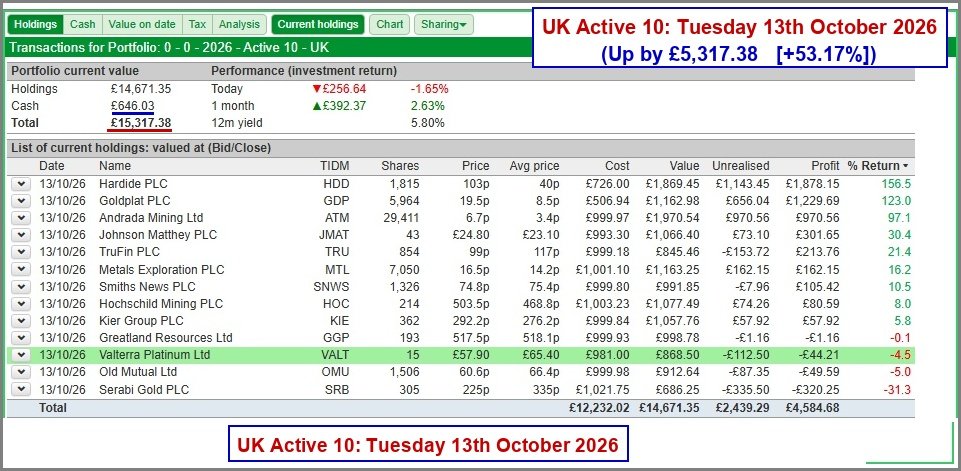
UK Active 10: Tuesday 13th October 2026 – Up by GBP 5,317.38 (+53.17%)
As at the close on Tuesday 13th October the UK Active 10 stood at GBP 15,317.38 against its GBP 10,000 start – up by GBP 5,317.38, or 53.17%. Since the September newsletter (GBP 14,925.01 on 11th September) it has added GBP 392.37, a gain of 2.63%. Holdings are GBP 14,671.35 with GBP 646.03 in cash, and the twelve-month yield is 5.80%.
Hardide [HDD] remains the standout at +156.5%, followed by Goldplat [GDP] at +123.0% and Andrada Mining [ATM] at +97.1%. At the other end, Serabi Gold [SRB] is down 31.3% and Old Mutual [OMU] down 5.0%.
Transactions
Since the last newsletter (14th September 2026), three items: a dividend of GBP 13.88 from Goldplat on 15th September; a new holding, Kier Group [KIE], bought on 16th September – 362 shares at 276.2p, for GBP 999.84; and a dividend of GBP 6.33 from Hochschild Mining on 2nd October. That left the cash balance at GBP 646.03.
US Active 10 Portfolio
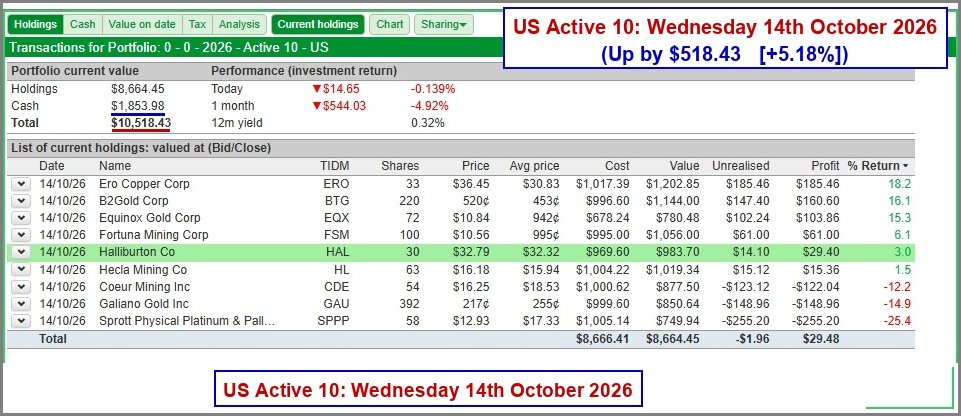
US Active 10: Wednesday 14th October 2026 – Up by USD 518.43 (+5.18%)
As at the close on Tuesday 13th October the US Active 10 stood at USD 10,518.43 against its USD 10,000 start – up by USD 518.43, or 5.18%. Since the September newsletter (USD 11,412.15 on 11th September) it has lost USD 893.72, a fall of 7.83%. Holdings are USD 8,664.45 with USD 1,853.98 in cash, and the twelve-month yield is 0.32%.
Ero Copper [ERO] leads at +18.2%, followed by B2Gold [BTG] at +16.1% and Equinox Gold [EQX] at +15.3%. At the other end, Sprott Physical Platinum and Palladium Trust [SPPP] is down 25.4% and Galiano Gold [GAU] down 14.9%.
Transactions
Since the last newsletter (14th September 2026), two dividends, both on 23rd September: USD 4.40 from B2Gold and USD 5.10 from Halliburton. There were no purchases or sales. That left the cash balance at USD 1,853.98.
Final Thoughts
That is almost it for this month. The next few weeks are unusually crowded: the US inflation figures on the day this goes out, the Budget and the Fed’s next decision both on 28th October, the US midterms on 3rd November and the Bank of England announcement two days later. I will pick up whatever matters most next month, and report back on the four indicators either way.
I am not making changes on the strength of any one of those dates. But with one of my four indicators now amber, I will be looking a little harder at the weaker balance sheets in both of our diy-investors portfolios. Perhaps worth doing with your own too?
Want to learn more about the techniques and strategies that we employ here at diy-investors.com? Then join our Inner Circle HERE.
Upcoming Members’ Webinars
Oct ’26 – Plaza Group Meeting: Wednesday 21st October 2026 (7.30pm)
AI for Investing (Oct. Meeting): Wednesday 28th October 2026 (7.30pm)
Nov ’26 – Inner Circle Webinar: Wednesday 4th November 2026 (7.30pm)
AI for Investing (Nov. Meeting): Wednesday 25th November 2026 (7.30pm)
Looking for earlier copies of the Freedom Blueprint?
The post containing the September Newsletter is HERE!
The post containing the August Newsletter is HERE!
The post containing the July Newsletter is HERE!
The post containing the June Newsletter is HERE!
Mick (14th October 2026)